
The honey bee queen’s spermatheca

The survival of a queen and her colony depends in part on her ability to sustain a large population. At the seasonal peak, she can lay about 1,500–2,000 eggs a day, more than her own body weight. Her paired ovaries contain roughly 360 ovarioles in total, where eggs form (Snodgrass, 1956). A queen needs a sufficient reserve of sperm to sustain fertilisation at high laying rates. She can keep stored sperm viable for years.
The role of the spermatheca
The spermatheca stores sperm and occurs in many insects and other invertebrates. In the honey bee queen it is a fluid-filled sphere about one millimetre across. Its wall includes a single layer of epithelial cells, and a network of tracheae covers the outside.
Stored sperm are largely immotile and retain their fertilising capacity in a specialised environment. The tracheal network surrounds the organ, and spermathecal glands contribute to its fluid (Fyg, 1983, and Koeniger, 1986, as cited in the original article). Measurements by Paynter et al. (2017) found very low oxygen inside the spermatheca, consistent with a greater reliance on non-aerobic energy production during storage.
After mating, sperm migrate from the oviducts to the spermatheca over roughly one to two days. Conditions during this period matter. Worker attendance, colony nutrition and population can influence the process (Woyke, 1983). Beekeepers can improve these conditions through colony management.
After returning from a mating flight, the queen receives close attention from workers. They follow her across the combs, touch her with their antennae, lick and feed her, and help remove the mating sign. Worker care and the queen's activity can support sperm migration. Egg laying generally starts several days after the final mating.
Colony conditions and seasonal changes affect egg production. Adequate nutrition supports egg development. A sufficiently large, healthy workforce warms the brood nest, cares for the queen and rears the brood. Laying varies with resources, colony demand and season.
As the queen ages, she may release fewer sperm per fertilised egg (Harbo, 1979). Older queens can produce fewer workers and more drone brood. Fyg (1983) described deposits of complex carbohydrate-associated proteins on the spermatheca, sometimes appearing from about two years of age. He suggested that such deposits might damage the wall cells and affect stored sperm.
Why reproductive status matters
To keep productive colonies economically viable, beekeepers need to know the origin, age and reproductive status of their queens. Unplanned queen replacement can reduce output and lead to the loss of desirable colony characteristics.
A field examination of the spermatheca can help clarify a queen's reproductive status. Comparing it with observations of the colony helps identify problems and make better-informed management decisions.
I usually examine older queens when replacing them or when a queen appears to be underperforming. The examination helps assess whether sperm entered storage and can support a diagnosis of a virgin or poorly mated queen. A young queen suspected of mating poorly may be examined if there are several eggs in one cell or eggs on the cell wall. Colony conditions matter too, since laying workers and insufficient laying space may produce similar signs. Appearance alone cannot predict remaining productive life. Research on some Varroa treatments has identified possible fertility effects in queens and drones, depending on the compound and exposure.
For queen breeders, field examination helps assess whether there are enough mature drones to achieve the desired mating quality and sperm stores. Adequate sperm reserves and genetic diversity both matter. Taylor and Rowell (1988) recommended placing drone-producing colonies one to two kilometres from mating stations in the setting they studied.
When the weather is marginal, examination can show whether queens stored sperm successfully. Combined with other quality measures, that information helps breeders assess and select their stock.
The examination also gives feedback when learning instrumental insemination. In my courses it provides a quick indication of progress. After insemination, queens are held in a queen bank for one or two days and examined to see whether sperm migrated to the spermatheca.
Waiting about two days after insemination allows sperm time to migrate from the oviducts. After one day migration may still be incomplete and the oviducts may contain semen, although cloudiness can show that some sperm have reached the spermatheca.
Field examination of the spermatheca
A queen's spermatheca can be examined in the field using the fingers or fine forceps. The test requires sacrificing the queen. Beekeepers can carry it out when removing a queen that has already been selected for replacement.
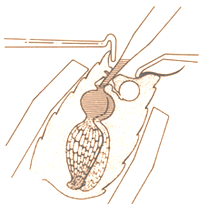
First, kill the queen promptly by crushing the head and thorax. Then grasp the last abdominal segment from its dorsal and ventral sides with a thumbnail or forceps. Separate the terminal segment from the body.
The gut and a large, translucent, irregular venom sac become visible. Among these tissues is a small, robust, spherical structure about one millimetre across. This is the spermatheca, with a transparent chitinous lining.
The organ first appears whitish and rough because a tracheal network covers it. Gently free the spermatheca from the surrounding tissue with the thumbnail.
To remove the covering, gently roll the spermatheca between the fingers. The tracheae collect into a separate white mass, exposing the organ.
Colour and opacity give a rough indication of the queen's reproductive status. Comparing specimens helps distinguish a virgin queen from one with stored sperm and can suggest whether a queen stored little sperm or has depleted reserves. The appearance gives a qualitative estimate.
The presence and intensity of colour reflect the contents of the spermatheca. A virgin queen's spermatheca is usually clear, and the transparent wall is visible.
In a queen with substantial sperm stores, the spermatheca is creamy or coffee-coloured with lighter and darker marbled swirls, resembling drone semen. Dense bands of sperm produce the pattern. The photographs compare a virgin and a well-mated queen.
A cloudy or milky appearance may indicate a smaller sperm reserve. Differences in shading reflect differences in sperm density. Direct counts and viability tests are needed for quantitative assessment.
A lack of contrasting marbling can suggest a low reserve. A queen that depletes her viable sperm may start laying more unfertilised eggs, which develop into drones. Examining queens at different stages helps the beekeeper recognise these visual patterns.
Queen assessment
Queen assessment is an essential part of beekeeping. Beekeepers who observe each colony and manage it carefully can use occasional dissection of a queen selected for removal to inform their decisions. That can help anticipate and prevent some economically costly problems.
A field examination can resolve some questions without specialised equipment. Beekeepers can learn to recognise differences in the colour and opacity of the spermatheca.
Assess the queen alongside the brood pattern and the condition of the colony. Recognising a persistent decline in laying can help determine when a queen no longer meets the colony's needs. Dissection can help clarify whether a queen suspected of being virgin or poorly mated stored sperm.
Sound management includes replacing queens whose performance has persistently declined. The quality of replacement queens varies. Uncontrolled mating can change the expression of selected traits over generations, with consequences for labour and production.
Used selectively, examination of the spermatheca helps beekeepers understand queen performance and investigate problems earlier. It is one tool for maintaining strong colonies with desired production characteristics.
Conclusion
Varroa profoundly changed beekeeping. Repeated chemical treatments can select for resistant mites. The bacterium that causes American foulbrood can also develop resistance to some antibiotics. Resistance and virulence are different traits, and routine chemical use can leave underlying colony vulnerability unaddressed.
The article calls for greater attention to breeding productive bees with natural resistance to diseases and parasites. Applying this approach requires understanding the relationship between bee biology and breeding.
Geneticist Rob Page likens bee breeding to pressing on a balloon: pressure in one place can cause unexpected changes elsewhere. The complexity and dynamics of honey bee behaviour create distinctive challenges, and many interactions remain to be understood.
Much agricultural progress has come from breeding animals and crops. Bee breeding faces particular constraints. Related matings can fix traits and increase uniformity, but honey bees are sensitive to inbreeding, notably because of their complementary sex-determination system.
Diversity and flexibility in behavioural traits help the colony function as a superorganism. Breeders must select production queens for several traits at once. Traits of economic interest are often behavioural, polygenic and strongly influenced by the environment, making assessment difficult.
Controlling mating adds another challenge. It is difficult to maintain selected stocks when queens mate with multiple drones of unknown origin. Isolated mating stations supplied with selected drones and instrumental insemination are ways to control parentage. Breeding programmes also require specialised work and long-term commitment.
The article reflects the state of practical bee breeding at the time it was written. Research has often focused on individual traits. Stocks selected for traits such as Varroa resistance offer a starting point for introducing resistance into commercial apiaries. The author notes that practical guidance on developing and running breeding programmes was then limited.
The Page–Laidlaw closed-population breeding programme offers a practical approach to improving commercial stocks (Page and Laidlaw, 1982). Their book Queen Rearing and Bee Breeding covers the technical foundations.
Growing beekeeper interest and new research methods offer opportunities to improve commercial stocks. This article introduces the basic elements of practical bee breeding. A broad supply of high-quality stocks can help build a healthier and more resilient industry.
The Spermatheca, by Susan Cobey (Italian translation by Gabriele Milli, from American Bee Journal, March 2003)


Comments