
Post-thaw dilution of dialysed, cryopreserved drone semen and honey bee queen fertility

Preface
Cryopreserving semen from honey bee drones (Apis mellifera) remains a challenge. Despite decades of research, the difficulty of preserving sperm viability and function after thawing still limits the practical use of frozen semen.
This study examined how diluting cryopreserved drone semen with Bee Semen Solution (BSS) after thawing affected sperm viability and queen reproductive performance. Queens were instrumentally inseminated with fresh or cryopreserved semen, with diluted and undiluted groups for each. The authors measured sperm count and quality in the spermatheca and assessed the brood pattern.
Cryopreservation reduced sperm viability and queen fertility compared with fresh semen. After thawing, BSS dilution showed a trend towards better spermathecal sperm parameters and queen fertility. The results suggest that post-thaw handling, including the choice of diluent, may help improve outcomes when semen is cryopreserved by a protocol that uses dialysis. The authors also propose investigating repeated insemination as a way to increase spermathecal sperm counts and improve queen fertility.
Introduction

Cryopreserving and storing honey bee drone semen remain challenges for instrumental insemination, breeding and research. Despite years of work on effective protocols (Melnichenko and Vavilov, 1975; Harbo, 1977; Kaftanoglu and Peng, 1984; Hopkins et al., 2012; Wegener et al., 2014a; Alçay et al., 2019), there is still no widely adopted method for maintaining semen fertility during long-term storage (Cobey, 2016; Smilga-Spalvina et al., 2023). Difficulties include freezing and storage and the effective insemination of queens with thawed material. Freezing and thawing can increase sperm abnormalities such as deformed heads and twisted tails (Yániz et al., 2024) and reduce sperm motility and viability (Hopkins and Herr, 2010; Özkök and Selcuk, 2020).
Several studies have examined the diluent used before cryopreservation and its effects on semen quality (Harbo, 1979; Taylor et al., 2009; Hopkins and Herr, 2010; Wegener et al., 2012; Alçay et al., 2019, 2022; Gulov and Laskin, 2021; Aktar et al., 2024; Nur et al., 2024; Mohammadi et al., 2025). Some commonly used cryoprotectants can harm spermatozoa, queens or both (Hopkins and Herr, 2010; Wegener and Bienefeld, 2012; Wegener et al., 2012). Diluting or removing much of the cryoprotectant after thawing may reduce its toxic effects (Wegener et al., 2014a; Gül et al., 2017; Auth and Hopkins, 2021). This has prompted interest in alternative diluents that stabilise sperm membranes after thawing while minimising damage. Few studies have examined the effects of post-thaw dilution on spermathecal sperm quality and queen fertility.
Wegener et al. (2014a) diluted cryopreserved semen with BSS and then centrifuged it to remove the cryoprotectant and reconcentrate the spermatozoa. Spermathecal sperm motility and queen fertility declined, and worker brood accounted for 27% of the brood. Gül et al. (2017) washed and centrifuged semen samples using a semen extender, glucose solutions or fresh drone seminal plasma. They found no significant increase in the proportion of worker brood. In both studies, centrifugation after dilution may have adversely affected sperm function and insemination success (Cobey et al., 2013). Wegener et al. (2014a) reported better sperm quality and queen fertility when they gently diluted the thawed samples with BSS and mixed them by hand without centrifugation.
Only three queens underwent that procedure, and the dilution ratio of one part semen to two parts BSS differed from the 1:1 ratio commonly used in queen insemination (Skowronek et al., 1995; Gerula et al., 2016; Kahya and Gençer, 2022). The present study examined how BSS dilution after thawing semen that was dialysed before freezing affected queen fertility and spermathecal sperm count and quality.
Materials and methods (read the full article)
Results
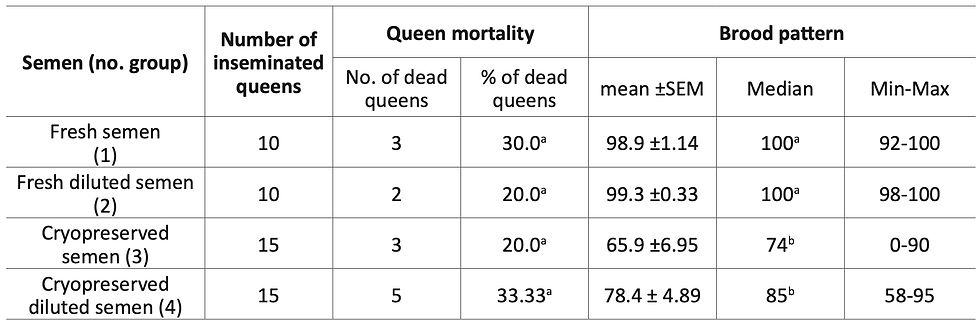
Motility reached 98% in the freshly collected semen and 62% in the thawed samples tested. Queen mortality did not differ significantly across the four treatments (Table 1). A Monte Carlo simulation gave χ² = 1.14, df = 3 and p = 0.77. Non-parametric analyses detected overall differences in the assessed reproductive and sperm traits. The proportion of worker brood differed between groups (Kruskal–Wallis H(3) = 28.13, p < 0.001).
Queens inseminated with cryopreserved semen (groups 3 and 4) produced a lower proportion of worker brood than queens inseminated with fresh semen (groups 1 and 2) (Table 1). Cryopreservation had a large effect (Cliff’s δ = 0.94–1.00). The two fresh-semen groups showed no significant difference (p = 1.000). Among the cryopreserved groups, BSS dilution was associated with a small to moderate estimated improvement (δ = −0.35 for group 3 versus group 4), which was not statistically significant.
Spermathecal sperm counts differed across treatments (p = 0.0005 as reported, Table 2). Queens inseminated with cryopreserved semen had lower sperm counts than those inseminated with fresh semen (p < 0.05, δ = 0.72–1.00). Post-thaw BSS dilution showed a trend towards higher sperm counts in the cryopreserved groups (δ = −0.30 for group 3 versus group 4, p = 1.000, Table S1). Sperm motility also varied across treatments (H(3) = 25.60, p < 0.001). Motility declined with cryopreservation (δ = 0.73–1.00). Post-thaw BSS dilution was associated with higher motility than undiluted thawed semen (δ = −0.52 for group 3 versus group 4, p = 0.26). Viability likewise varied across treatments (H(3) = 23.70, p < 0.001).

Cryopreservation was associated with substantially lower viability than fresh semen (δ = 0.83–1.00). The estimated difference in viability between the two thawed groups was negligible (δ = 0.03, p = 1.000, Table S1).
Discussion
Cryopreservation affected the count and quality of sperm stored in queen spermathecae, as reported in earlier studies (Harbo, 1983; Kaftanoglu and Peng, 1984; Hopkins et al., 2012; Wegener et al., 2012, 2014a; Gül et al., 2017; Paillard et al., 2017; Gulov and Laskin, 2020, 2021; Yániz et al., 2020; Nur et al., 2024; Egyptien et al., 2025; Mohammadi et al., 2025). Relatively few studies have assessed the fertility of queens inseminated with cryopreserved semen, and these differ in freezing protocols and in the diluents used before or after freezing. An important practical measure is whether a queen can produce enough workers to support colony growth (Bryła and Trzcińska, 2024) or enough fertilised eggs to rear replacement queens and preserve genetic lines for selective breeding (Wegener et al., 2012).
Queens inseminated with cryopreserved semen can lay fertilised eggs, although fertility outcomes vary. Early single-insemination trials reported egg laying with 3.3 µL or unspecified volumes, respectively, but low worker brood proportions (8–22% and 47%) and spermathecal counts (0.1–0.2 million spermatozoa) (Harbo, 1983; Kaftanoglu and Peng, 1984). The effects of different extenders have varied. Wegener et al. (2012) reported lower spermathecal counts after cryopreservation with dimethyl sulfoxide (DMSO), at 0.7–1.3 million compared with 2.4–3.6 million for fresh semen. Addition of cryoprotectant by dialysis yielded 49–79% worker brood. Gentle post-thaw dilution without centrifugation yielded up to 65.8% worker brood and up to 1.8 million spermathecal spermatozoa in the reported experiments (Wegener et al., 2014a).

Hopkins et al. (2012) found that queens inseminated with 5 µL of cryopreserved semen could produce fertile offspring across generations. Fertilisation reached 95–100% in the best cases and averaged 50% initially and 46% in the first generation. Subsequent studies modified freezing and insemination protocols to improve post-thaw sperm viability and queen fertility. Gül et al. (2017) reported that queens inseminated once with 5 µL of thawed semen washed in drone seminal plasma produced comparable proportions of worker brood to frozen controls (48% and 47%, respectively), with spermathecal counts of 0.81 and 1.6 million, respectively. They found no significant improvement. Some alternative pre-freezing diluents, including honey-based solutions, yielded more promising results.
Gulov and Laskin (2020, 2021) reported that queens inseminated once with 8–12 µL of cryopreserved semen produced 17–99% worker brood (mean 61%) and stored a mean of 1.98 million spermatozoa in the spermatheca. Nur et al. (2024) achieved egg laying with single inseminations of 8–10 µL using diluents without cryoprotectants, but did not report brood or sperm data. Excessive dilution lowered spermathecal counts to 0.14–0.15 million regardless of centrifugation (Paillard et al., 2017).
Using a simple antibiotic-free freezing protocol, Egyptien et al. (2025) obtained fertilised eggs from a small proportion of queens inseminated once with 5 µL of cryopreserved semen, showing that the method was feasible but had limited efficiency. In the present study, worker brood reached up to 90% (mean 66%) with undiluted thawed semen and up to 95% (mean 78%) with diluted thawed semen. Mean spermathecal sperm counts were 1.86 and 2.04 million, respectively.
Together, these studies show that cryopreserved semen can support fertilisation and worker production, with outcomes depending on the insemination volume, semen handling, including dilution and centrifugation, and the cryoprotectant or diluent. In the present study, queens were inseminated twice, which may partly explain the differences in spermathecal counts from earlier studies. Woyke (1960), Mackensen (1964) and Bieńkowska et al. (2011) found that splitting a dose across two inseminations increased spermathecal sperm counts compared with a single insemination.
Bolten and Harbo (1982) also found that inseminating a queen twice with small amounts of diluted thawed semen delivered significantly more spermatozoa to the spermatheca than inseminating her once with the same total volume. The second insemination delivered 68–77% more spermatozoa than the first. Gąbka (2021) found no difference in the onset of egg laying among queens inseminated with different semen doses. Repeated insemination may also increase the risk of semen contamination and infection of the queen (Gąbka, 2021; Smilga-Spalvina et al., 2023).
Repeated insemination may therefore be worth investigating as a means of increasing the number of spermatozoa that
reach the spermatheca, particularly with cryopreserved semen, because freezing can reduce sperm viability and motility and thereby affect queen reproductive performance (Wegener et al., 2012; Yániz et al., 2024). Dilution in a suitable medium may have influenced the results, although diluting fresh semen did not significantly improve the parameters measured. Earlier experiments with fresh semen found little effect of dilution on insemination outcomes (Mackensen, 1969; Skowronek et al., 1995; Lodesani et al., 2003; Gerula et al., 2016; Gąbka and Cobey, 2018; Kahya and Gençer, 2022). Across the diluents and dilution ratios examined, these studies found no significant differences in spermathecal counts between queens receiving diluted and undiluted fresh semen.Dilution likewise produced no statistically significant differences between the two cryopreserved semen groups. The authors suggest that dilution could have a greater effect after dialysis against a hypertonic cryoprotectant solution, as in this experiment. Dialysis draws water out of the semen, and post-thaw dilution may help restore osmolarity and viscosity. This could explain the higher values observed for diluted thawed semen when the authors compared means, medians and effect sizes (Cliff’s delta). The trends were most apparent for sperm motility, sperm count and worker brood.
Trehalose, an ingredient of BSS (Wegener et al., 2014a), occurs naturally in drone seminal fluid (Blum et al., 1962). Compounds in this fluid, including proteins, amino acids and sugars, can help maintain sperm viability during storage (den Boer et al., 2009). Nur et al. (2020) reported that adding 0.1 or 0.05 M trehalose to a freezing medium with 12% DMSO improved post-thaw sperm motility and plasma membrane integrity. Tsvetkov et al. (2024) found higher post-thaw motility and better sperm movement parameters with trehalose without DMSO than with DMSO or glycerol. BSS containing trehalose could partly offset losses of motility and help sustain fertilisation.
Many spermatozoa are lost or lose viability during transfer through the oviducts to the spermatheca. After natural mating, only about 3–5% reach the spermatheca (Yániz et al., 2020). Any additional loss of motile sperm after cryopreservation could therefore affect queen fertility. Paillard et al. (2017) reported a higher risk of failing to lay fertilised eggs when fewer than 0.5 million spermatozoa reach the spermatheca. Semen dilution may help the sperm disperse.
Dilution can also reduce semen viscosity (Tofilski, 2014; Bratu and Pătruică, 2021). Semen is dense and tends to clump, particularly when collected from older drones, and can be difficult to draw into a narrow insemination tip (Cobey et al., 2013; Czekońska et al., 2013; Bieńkowska and Panasiuk, 2006). Dilution could make semen easier to deliver during insemination and help spermatozoa move through the queen’s reproductive tract.
Further studies of diluent composition and insemination protocols are needed to improve queen fertility and make semen cryopreservation a practical tool for honey bee breeding and genetic conservation.
Published in December 2025 · Journal of Apicultural Science · DOI 10.2478/JAS-2025-0013
Authors
Mikołaj Borański, Małgorzata Bieńkowska, Beata Panasiuk and Dariusz Gerula · The National Institute of Horticultural Research, Poland
Jakob Wegener · GrüBie Ashiralieva&Wegener Gbr, Germany
Italian translation by Davide Simeone

Comments